

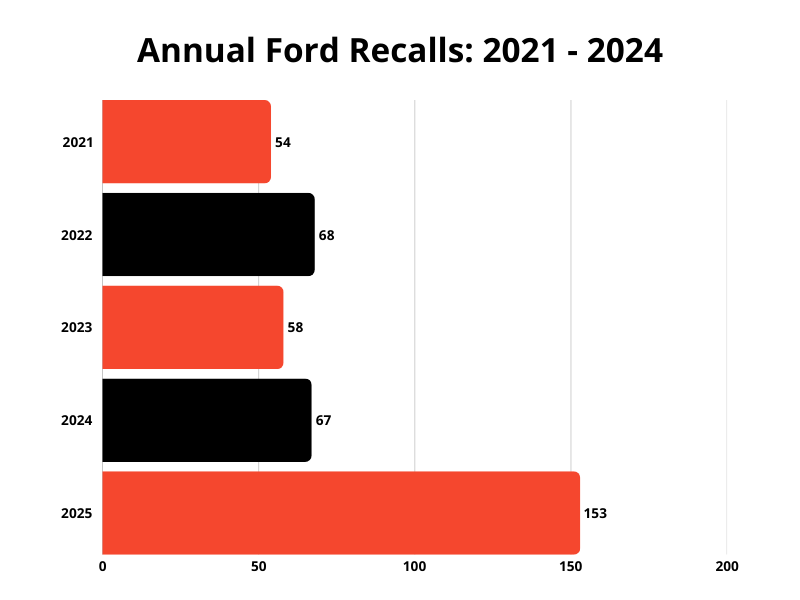
Almost every automaker can be expected to issue at least a handful of recall orders each year to address shortcomings and defects with their vehicles. However, no automaker is keen to claim the dubious honor of “most recalls issued in a calendar year.” In 2025, Ford Motor Company (Ford) set a new record with 153 recalls issued throughout the year. Prior to 2025, the highest number of auto recalls issued in a single year was 77 (General Motors, 2014). With the sheer number of recalls issued in 2025, it seems that Ford’s record is here to stay.
What is a Vehicle Recall?
A recall order is issued when a “vehicle, equipment, car seat, or tire creates an unreasonable safety risk or fails to meet minimum safety standards.” When a recall is issued, the responsible vehicle manufacturer must offer an acceptable remedy to mitigate risks to drivers, passengers, and the public. Remedies may include free repairs, replacement of defective parts, a refund, or (in rare cases) a vehicle buyback. In almost all cases, vehicles can be repaired and returned to the road.
Has Ford Always Issued a High Number of Recalls?
According to a Ford recall study created by Woodard Injury Law, the company has consistently led all automakers in the number of recalls issued annually for several years. Ford issued more recalls in 2022, 2023, and 2025 than any other automaker. Tesla and Stellantis briefly surpassed Ford in the number of recalls issued in 2024, before Ford’s staggering 153 recall orders in 2025.
It’s worth noting that not all recalls are issued for problems that create immediate life-or-death consequences for drivers and their passengers. An automotive recall may be issued for something as minor as excessively small font on a screen display or a glitch affecting a car’s backup camera. All safety concerns should be addressed as soon as possible, but these minor problems do not pose the same level of risk to operators as issues like brake defects, engine stalls, or the possibility of spontaneous vehicle fires.
Has Ford Taken Action to Improve Build Quality & Reduce Recalls?
Ford’s track record of recalls over the past five years leaves much to be desired in terms of the quality and reliability of the brand’s vehicles. No vehicle owner wants to run the risk of being stuck with their car in the shop multiple times a year, much less to correct the same issue multiple times. To their credit, Ford has taken action to address the build quality of their vehicles.
In 2024, the National Highway Traffic Safety Administration (NHTSA) issued Ford a $165 million fine for delayed action in recalling vehicles with defective rearview cameras. As part of the action taken by the NHTSA, an independent third party was assigned to monitor Ford’s compliance with the Vehicle Safety Act and federal safety standards for at least the next three years.
Ford was also required to audit the efficiency of past reviews, which uncovered a problem with the automaker’s software update system. In some instances, software patches would fail but be reported as successful by Ford’s system. This meant that some recalled vehicles never received necessary safety updates, despite being returned to owners under the impression that recall work was successfully carried out.
To address the company’s considerable struggles with quality control, Ford underwent significant leadership changes in 2024. The company also introduced the Mobile Artificial Intelligence Vision System (MAIVS) into many of its plants across the world. MAIVS uses machine learning and computer vision to detect vehicle defects in real-time, allowing for immediate action to be taken to address potential problems. Fixing errors as they occur saves vital time and reduces the risk of safety issues going unnoticed as a vehicle is built.
Where Does Ford Go From Here?
Ford has undoubtably taken steps to improve the quality of their vehicles and reduce the frequency of recalls, but their efforts have yet to pan out. The sheer number of recalls issued, number of units affected, and fact that many vehicles have been recalled repeatedly for the same issue(s) fail to generate much confidence in the automaker’s existing quality control processes. Hopefully, Ford is able to continue to lean into advanced problem detection systems that catch problems before vehicles ever leave the factory floor. It may be an uphill climb, but there is a path for Ford to resume its position as a quality manufacturer of American vehicles.







No Comment