

There have been plenty of headlines in the news lately about self-driving cars. From Waymo’s expansion into new cities, to issues with blocking emergency vehicles, to the recent child pedestrian accident, there are plenty of stories to go around. There’s absolutely no denying that the rise of robotaxis presents a variety of new safety concerns.
But many people want to know: are robotaxis better drivers than humans?
A new autonomous vehicle (AV) accident study by law firm Dulin McQuinn Young examined AV incident data to try to answer this question. Specifically, they analyzed NHTSA incident reports from the last four years to better understand who was at fault for accidents involving autonomous vehicles.
The findings may surprise you.
The Numbers at a Glance
To start, let’s look at some quick statistics.
From 2021-2025 there have been 2,081 incidents involving autonomous vehicles (ADS only – so Tesla was not included). Of those, 2,052 included narratives; the remaining ones did not, making it impossible to determine fault.
Here’s the breakdown by fault:
- 234 accidents were caused by an AV. However, 157 of those only involved the AV; 77 involved another vehicle or person.
- 1,705 accidents were caused by another road user
- 36 accidents had shared fault
- 22 accidents were unavoidable or fault was unclear
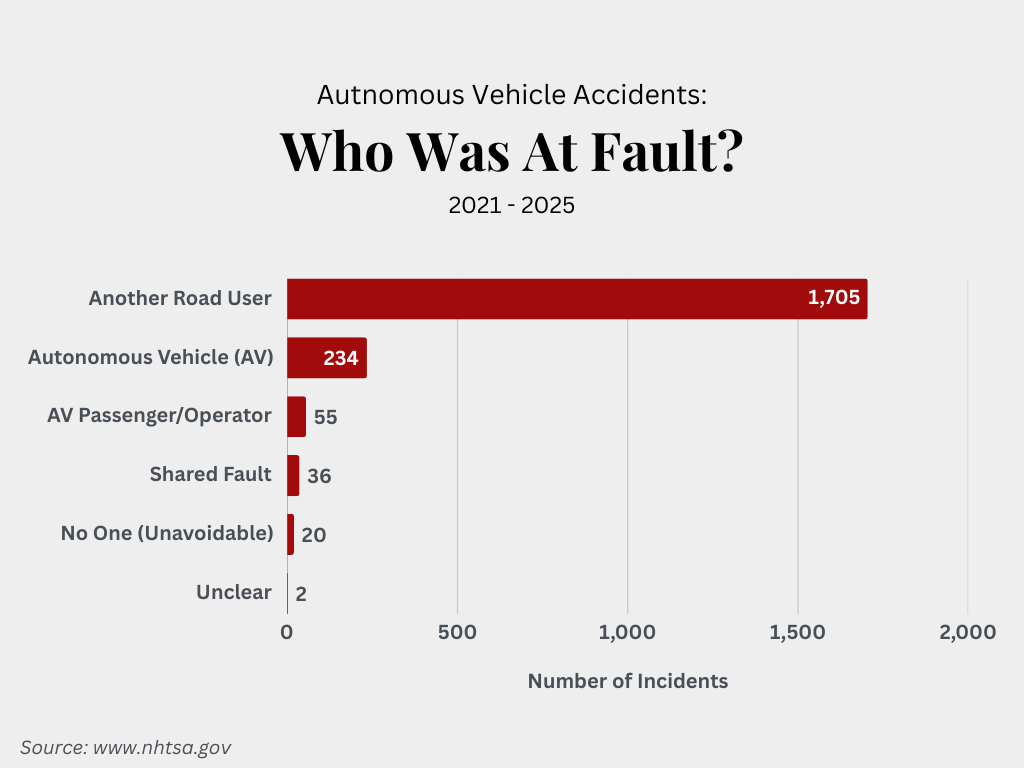
Source: Dulin McQuinn Young
Common Accidents Caused by Autonomous Vehicles
Below are the most common accidents caused by AVs. Note that these only reflect accidents caused solely by self-driving cars, not the shared fault incidents.
Traffic Collisions (25)
The most common accident types involving AVs are rear-end collisions and incidents during merging or lane changes.
Maneuver Errors (23)
The second most common incident type involves low-speed clearance misjudgments, where an AV incorrectly gauges available space, often hitting a parked vehicle.
Hitting Animals (21)
The third most common incident type is striking animals: AVs injure or kill animals much more often than humans. 21 animals have been injured or killed by self-driving cars, and only 14 humans have been injured.
Do AV System Malfunctions Cause Accidents?
Surprisingly, only 2% of accidents caused by an autonomous vehicle happened because of a system malfunction.
This isn’t to say that system malfunctions can’t be dangerous in other ways – for example, at least one passenger has gotten stuck inside a Waymo due to a malfunction.
But when it comes to accidents, there have only been a few incidents. For example in one instance, a self-driving car mistook a road sign for a pedestrian and slammed on the brakes suddenly, causing a collision. In another, outdated maps led to a poor driving maneuver. No injuries have occurred due to a software or hardware issue.
The State of Robotaxi Safety
At the moment, with robotaxis continuing to slowly test and operate in a handful of cities on surface roads, their accident and injury rate doesn’t seem too concerning. However, robotaxi accidents will only continue to increase with more of them on the road and as they expand onto highways.
Additionally, there are already safety concerns beyond collisions. Robotaxis have had continuous issues with blocking emergency vehicles, hindering the ability to get life saving care to people who need it. Most recently, a Waymo blocked an emergency vehicle after the mass shooting in Austin on March 1, 2026. Fortunately, officers were trained on how to handle the situation and got the ambulance through without too much delay, but it points to a situation that could become life or death.
As more self-driving cars continue to roll out, only time will tell what additional safety concerns arise. Autonomous vehicle companies like Waymo have a responsibility to ensure that this technology helps improve safety, not compromise it.



No Comment